
Dental Implant Failure & Salvage – Worcester, MA
Reclaiming Your Smile

Dental implant salvage is not something you hear about often. The reason is that there is such a high success rate for patients who receive dental implants to replace their missing teeth. With more than 95% of cases proving effective, it’s highly unlikely that any problems will arise. But the last 5% may cause you to wonder what can happen should a failed dental implant occur. At Handsman & Haddad Periodontics, our team is ready to provide safe and effective solutions that are designed to save implant smiles. Call us today to learn more about what we can do to help you regain confidence in your prosthetics.
Why Do Dental Implants Fail?
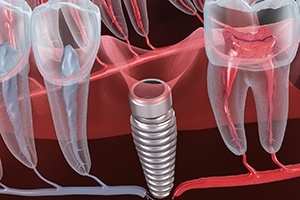
When it comes to the failure of a dental implant, it is likely due to one of the following reasons:
- Peri-implantitis
- A weakened immune system
- Improper placement
- Facial trauma
- Failed osseointegration
Choosing someone skilled and qualified to perform dental implant placement is essential, especially since much of your success is determined by their ability to correctly place and position each post. However, apart from finding the right professional to complete the work, your commitment to optimal oral health is just as important and can be just as devastating.
Symptoms of Failed Dental Implants

If you’re unsure what you should look for when it comes to failed dental implants, here are a few symptoms to keep an eye on:
- The dental implant feels loose
- Pus forms on the gums near the implant
- You have difficulty eating or biting down
- There is swelling or bleeding near the implant
- You experience discomfort that doesn’t dissipate after surgery
How Dental Implant Salvage Works

How failed dental implants are treated is ultimately dependent on what is causing them to fail in the first place. Because peri-implantitis is a leading cause of implant failure, it is necessary that our team address this disease that is quite common to regular gum disease. And because jawbone deterioration may occur as a result, we may also suggest additional bone grafting to build up the density within your jawbone. If we can do this without removing your implant, we will, but there is no guarantee.
If facial trauma, failed osseointegration, or improper placement are the reasons, we’ll likely need to remove the implant and allow the gum tissues to heal before attempting to reinsert new dental implants.
The same can also be said if you have an autoimmune disorder or condition that prevents dental implant success. However, in this case, you will need to work closely with your local physician to determine a solution that will allow you to better manage your condition while also enjoying the benefits of dental implants.
Dental Implant Failure & Salvage FAQs
What are the Early Signs of Dental Implant Failure?
If something has gone wrong with your dental implant, it’s important to seek treatment from a professional as soon as possible. Fortunately, dental implant failure in Worcester is often accompanied by the following early warning signs:
- Severe Pain: Some mild, temporary discomfort is to be expected after your dental implant surgery. Severe pain that lasts longer than expected is often a sign that something has gone wrong.
- Gum Recession: Does your dental implant crown look longer than normal? This might be a result of gum recession, which could potentially be the side effect of a gum infection.
- Difficulty Chewing: By the end of the dental implant process, you shouldn’t have any trouble chewing or biting a wide variety of foods. If you’re finding it difficult to eat lately, there’s a chance that your implant posts may have failed.
- Shifting Implant Post: Do you feel your dental implant moving when you speak or eat? It may be a sign that the implant post is not properly fused with the jawbone.
Can an Infected Dental Implant Be Treated Without Removing It?
It depends on the situation. If the infection is still in its earliest stages, it may be possible to address the problem with conservative measures (such as a deep cleaning or antibiotics) that don’t require removing your implant posts. On the other hand, if you’re suffering from a more advanced infection that has resulted in bone loss, we may need to take your posts out of your mouth so that the problem can be properly treated. You might be able to get new dental implants once your mouth and jaw are healthy again.
What Increases the Risk of Dental Implant Failure?
Some common risk factors for dental implant failure include:
- Poor Oral Hygiene: If you don’t make a point of brushing and flossing regularly, you could be at a higher risk of developing an infection that could lead to dental implant failure.
- Smoking: If you smoke shortly after receiving dental implants, it could complicate the healing process. On top of that, tobacco products can make the mouth more susceptible to infection.
- Certain Health Issues: There are certain health conditions that are linked to a higher chance of dental implant failure, such as untreated diabetes.
Do Regular Dental Visits Help Prevent Dental Implant Failure?
Yes, visiting your dentist twice a year can help minimize the risk of your dental implants failing. A routine checkup allows your dentist to check on the condition of your implants and the tissues around them. They’ll let you know if they find any problems and explain what your options are for addressing them before they can lead to dental implant failure.
When Should I See a Dentist About Implant Pain?
You shouldn’t experience discomfort in the area around a dental implant once your mouth has fully healed. As such, if you notice any pain that occurs near your implant post, you should call our office immediately to schedule an appointment. The sooner you get to our office, the sooner we’ll be able to figure out what’s causing the problem.
How Common are Dental Implant Infections?
Dental implant infections are relatively uncommon but not unheard of; they are estimated to occur in about 5% to 10% of cases. Factors such as poor oral hygiene, smoking, and certain systemic health conditions can increase your risk of developing an infection around your dental implants. As such, if you want to keep the area around your dental implants healthy, you should make a point of thoroughly brushing and flossing at least twice a day.
How Do I Know If My Implant is Infected or Just Irritated?
It’s normal to experience some mild irritation during the first few days after your dental implant surgery. You may notice some redness and swelling, but these symptoms should eventually fade on their own. That being said, if swelling occurs after the area around your dental implant has healed, it’s likely a sign of infection; this is especially the case if it’s accompanied by bleeding and a persistent bad taste.
